

Thermochemical Copper-Chlorine (Cu-Cl) Cycle
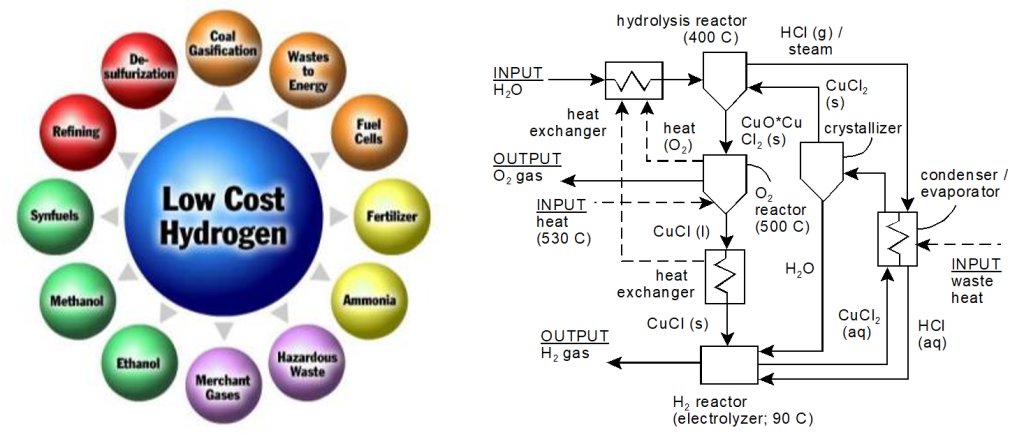
The Cu–Cl cycle involves four chemical reactions for water splitting, whose net reaction decomposes water into hydrogen and oxygen. All other chemicals are recycled. The process can be linked with nuclear plants or other heat sources such as solar and industrial waste heat to potentially achieve higher efficiencies, lower environmental impact and lower costs of hydrogen production than other conventional technologies. Recent advances by the team been reported for unit operations, alternative reactor configurations and pressure swing distillation for hydrochloric / water separation. Ongoing research focuses on reduced steam consumption in the hydrolysis reactor to improve overall cycle efficiency and scaling up lab-scale operations towards an industrial pilot plant and commercialization.
Photocatalytic Water Splitting for Solar Hydrogen Production
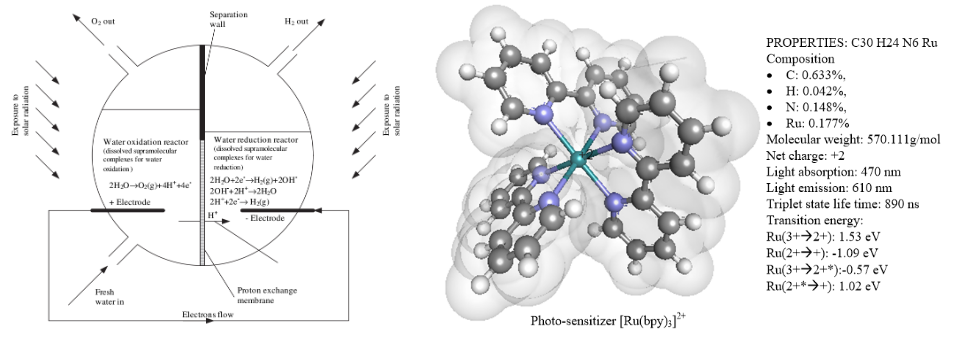
This research has developed new methods of photochemical water splitting for hydrogen production from incident solar radiation. Photocatalytic half-reactions of water reduction and oxidation uccur in two reactors divided by a proton conducting membrane. Complex molecules based on ruthenium-(bipyridine) photosensitizers are dissolved in both reactors, which generate electrons or holes when exposed to photonic radiation, and act as catalysts for water splitting. The selected molecules for water reduction have a unique property to enhance the existence time of photoelectrons, such that the likelihood of generated electron pairs to produce a molecule of hydrogen is increased. The research findings have indicated a promising potential for photocatalytic production of hydrogen from solar energy.