

Heat Transfer in Gas-Particle Reacting Flows
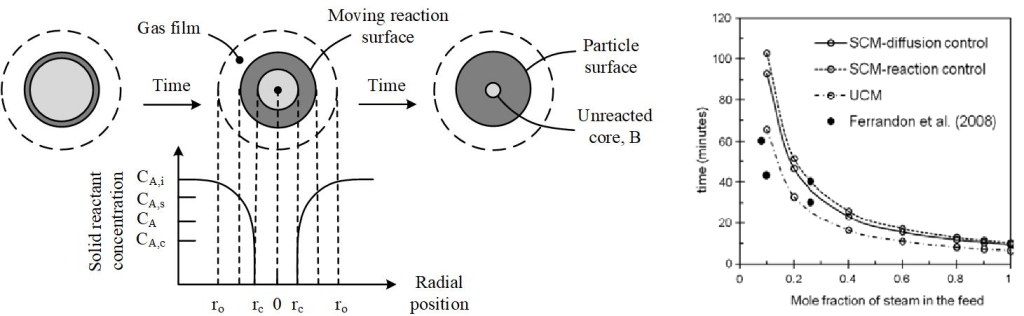
Biomass pyrolysis involves the thermal decomposition of organic materials. It converts agricultural and forestry waste into bio-oil, syngas (for heat / electricity), or biochar (for carbon sequestration and soil enhancement). Gas-particle reactions occur as the biomass decomposes and releases volatile gases. This research has investigated gas-particle interactions between the carrier gas and biomass particles to determine how rapidly heat penetrates and decomposes the particles. The processes of heat transfer affect the relative yields of bio-oil and char production. Ongoing research into gas-particle reacting flows is also examining copper chloride hydrolysis in the Cu-Cl cycle of hydrogen production to reduce steam consumption and improve overall cycle efficiency.
Multiphase Flow with Droplets on Iced Surfaces
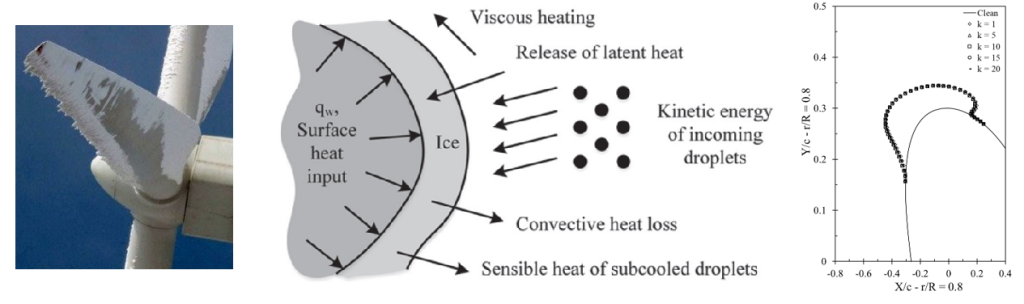
Ice accumulation on wind turbines, ships, and aircraft causes severe stability, safety and performance loss problems. This research has predicted and mitigated atmospheric and sea spray icing of structures through numerical modeling with CFD (computational fluid dynamics). CFD solutions for the flow field are obtained for comparisons of the velocity, droplet trajectories, pressure coefficient, ice thickness, and ice shapes with experimental data. Scaling studies have provided new insight into the prediction of ice accretion on large actual structures in the field based on scaled smaller prototypes tested in a laboratory setting.
Combustion and Convective Droplet Burning
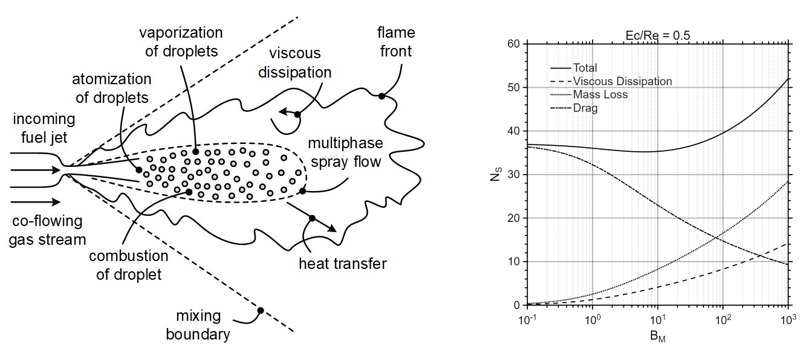
This research has investigated the entropy generation of burning liquid fuel droplets in high-temperature environments. A second law analysis includes transport processes of heat transfer, viscous dissipation and convective burning of droplets. The research is examining the heat transfer and breakup of droplets using computational methods with a population balance model. Entropy generation of the Stefan flux arises from convective flow of gas away from the droplet as it evaporates, combined with diffusion to create an enhanced total heat transfer rate. The findings provide useful insight for improving the thermodynamic efficiency of fuel injection in combustion engines.