
Building Spectroscopes for Girls Get WISE

image1On Friday, April 29, about 65 junior high girls joined us at UPEI for the 3rd annual Girls Get WISE Science Retreat. WISE stands for Women in Science and Engineering which is a movement to encourage girls to consider careers in areas of science and engineering which are traditionally male-dominated. Girls participated in group activities, workshops in Chemistry, Engineering, and Physics, and had the opportunity to talk with women who are working in or studying science and engineering.

2016 Girls Get WISE participants: junior high girls, volunteers, workshop leaders, and mentors.

2016 Girls Get WISE participants: junior high girls, volunteers, workshop leaders, and mentors.

Finished spectroscope

A simple spectroscope made from a cardboard tube. The clear “window” on the end is a stripped-down piece of CD.

For the Physics workshop this year, we decided to do an astronomy-themed activity. The girls built simple spectroscopes from cardboard and old CDs and then looked at different light sources to see their spectra. It was fitting that the girls got to learn about spectroscopy, as pioneering work on that topic was done by some of the first women to work in astronomy.

While the girls were building their  spectroscopes, they had an opportunity to go outside to have a safe look at the Sun through our solar telescope. We were lucky to have a beautiful sunny day with very few clouds in the sky, so everyone got to have a look at the Sun’s surface and see some sunspots and prominences.
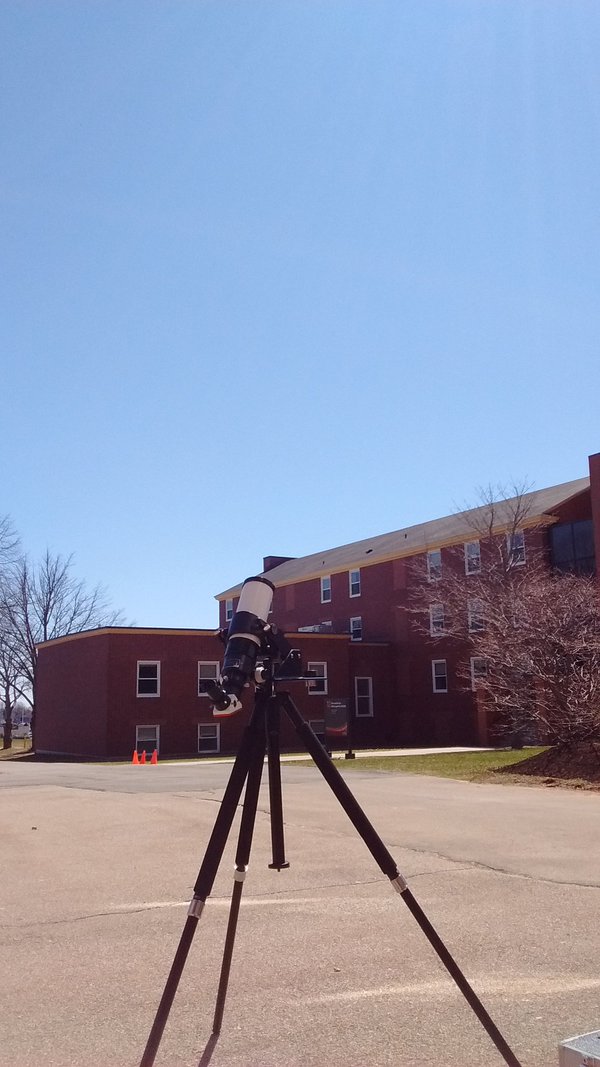
A beautiful clear sunny sky for solar viewing during the WISE physics workshops.

A beautiful clear sunny sky for solar viewing during the WISE physics workshops.

You can build your own spectroscope at home using our instructions and then look at different light bulbs, LEDs, and reflected sunlight to see the different spectra that they produce. It’s not safe to look directly at the Sun using your spectroscope, but if you put some white paper in a sunny patch, you can look at that reflected light safely . And if you’d like to get a safe look at the surface of the Sun, come to one of our public solar viewings sometime.Sun warning

April Solar Viewing: POSTPONED to April 30

UPDATE (Sat, Apr 23)

The current weather forecast is showing cloud coverage during the scheduled viewing period of 11:00 a.m. to 1:00 p.m. on Saturday, April 23. Although the sky looks nice and clear now, a look at the satellite data shows PEI to be currently under just a tiny gap in a large cloud mass, so not a good day for seeing the Sun later on.

We’ll try again next week – Saturday, April 30, 11:00 a.m. to 1:00 p.m. Third time’s the charm?

We’ll be viewing the surface features of the Sun through an H-alpha filter using our solar telescope. You’ll find the telescope set up in UPEI Parking Lot A across from the Farmers’ Market (see campus map here).

April 6th viewing – Jupiter and Galilean Moons

We managed to have a beautiful clear sky for the first hour of our viewing last night. Dark intermittent clouds moved in around 9:30pm, but by then all of our 18 guests had gotten a good look at the night’s viewing object, Jupiter and three of its four Galilean moons (so called because Galileo was the first to observe them and their motion around Jupiter).

For those who attended the viewing and would like to know which moons they saw, you can use a program like Stellarium to find out. The image is a screenshot from that program, showing Jupiter as it was seen at 9pm on April 6. (The view through our telescope was the mirror image because of how the optics of the telescope work.)

Jupiter 9pm April 6

The moons of Jupiter that were visible during the April 6th public viewing.

The three moons that were visible during the viewing, in order of increasing orbital distance from Jupiter, were Io, Europa, and Ganymede. The Galilean moon that orbits the farthest out from Jupiter, Callisto, wasn’t visible during the viewing. However, the orbital period of all these moons is quite short – between about 2 to 17 days – so which moons are visible changes rapidly. If one were to look at Jupiter at 9pm tonight (if the clouds weren’t in the way!), one would be able to see the moon Callisto, but the moon Io would not be visible as its orbit takes it behind Jupiter.

Jupiter 9pm April 7

The moons of Jupiter that would be visible on the evening of April 7th.

April Public Viewings

After a long winter of little success with telescope viewing plans, we finally have some public viewings scheduled this month.

We have to hold off on nighttime viewings during the university examination period (as classrooms are booked up for exams and students need quiet in the buildings while they’re writing), so we’re trying to get in a nighttime viewing before exams start on April 8 and then we’ll have a solar viewing later in the month. As always, these events are weather dependent, so for any updates on whether a viewing is going ahead, check here.

  • Nighttime telescope viewing: Wednesday, April 6 from 8:30 to 10:00 p.m.
    • Cloud-date: Thursday, April 7
    • Meet in room 417 of Memorial Hall (location of building and information on parking can be found here)
    • We’ll view Jupiter since it’s prominent in the sky right now, and perhaps some other interesting objects if the weather cooperates.
  • Daytime telescope viewing: Saturday, April 16, 11:00 a.m. to 1:00 p.m. (times may be adjusted if there is intermittent cloud)

Telescope in Libraries program

We are pleased to announce that the Confederation Centre Public Library now has a telescope that can be borrowed by library patrons. This came about through a partnership between the library, the Sidewalk Astronomers of CharLibrary Telescopelottetown, and UPEI Physics.

The telescope is a Sky Watcher 6″ Dobsonian and is easy to use so even beginner astronomers can be up and going in a short time.

Information about reserving the telescope can be found on the Library’s website. UPEI Physics helped put together a user guide (which is provided when the telescope is borrowed from the Library) and also an introductory video on using the telescope.