We invite you to visit the Earl L. Wonnacott Observatory this fall to look through our telescope. We will be pointing our telescope at various objects of interest: the moon, planets, stars, nebula, and galaxies, depending on the date and sky conditions.
We will once again schedule viewings roughly every two weeks this semester, anticipating that at least half of the events will be cancelled by cloudy weather.
In the event of cloudy weather, this post will be updated to indicate if a viewing is cancelled.
The dates and times that we’ve scheduled are below. Note that the event times shift earlier as the dates get closer to the winter solstice.
Saturday, October 3, 8:00-10:00 PM – attended by 53 people. We viewed the Double Cluster and Saturn.
Saturday, November 7, 6:30-8:30 PM (cloud-date: Saturday, November 21, 6:00-8:00 PM)
Saturday, December 5, 6:00-8:00 PM
Monday, December 21 (winter solstice), 6:00-8:00 PM
If you’re coming to our event, meet us in room 417 of Memorial Hall. We’ll have some astronomy activities and information for a variety of ages that you can peruse while you wait for your turn to go up to the observatory.
Accessibility: You can take an elevator up to room 417, but it is necessary to climb stairs up one floor to the roof and into the observatory to reach the telescope.
There will be a partial solar eclipse visible from PEI on the afternoon of August 12.
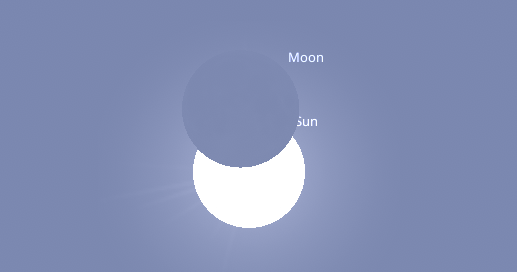
A simulated view of the eclipse at maximum, when 34.7% of the sun is blocked by the moon. Screenshot from Stellarium software.
The eclipse begins at 1:54pm when the moon first contacts the sun’s edge. The maximum coverage will occur at 2:57pm when 34.7% of the sun’s disc will be blocked by the moon. At 3:57pm, the moon will no longer be covering the sun at all. You can watch a simulation of the full eclipse here.
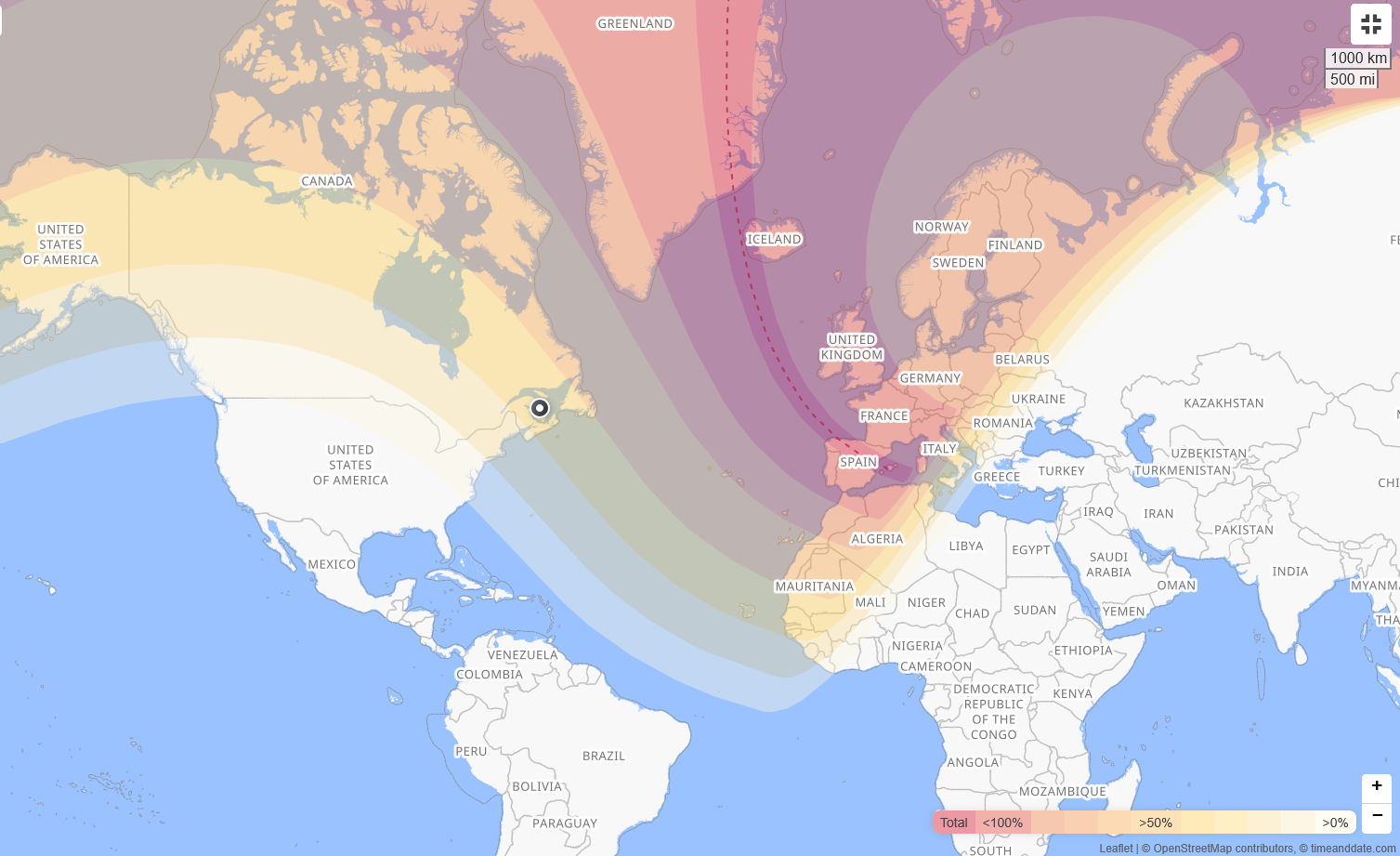
Only parts of Greenland, Iceland, and Spain will experience totality for this eclipse.
The solar eclipse path of totality, marked in red, and the regions that will experience partial eclipses. Screenshot from TimeAndDate.com
Viewing the Eclipse Safely
You can safely view the partial eclipse by wearing eclipse glasses or using projection methods. If you’re planning to view this event at home, you may find our advice on safely viewing the sun useful (that post was written in preparation for the April 2024 total solar eclipse).
Our Viewing Event
If you’re able to travel to the UPEI campus (and if the weather cooperates), you can view the eclipse at our special viewing event. We’ll be set up in the same location that we hold our regular summer sun viewing events, with three different solar telescopes – two at ground level, and one in our observatory. In addition to seeing the moon in front of the sun, you’ll also be able to see other solar features through our different telescopes. We have lots of eclipse glasses left over from April 2024, so you can watch the eclipse through the glasses while waiting for a look through the telescopes.
Join us in the grassy area between the corners of Memorial Hall and Dalton Hall between 1:50-4:00pm, weather permitting (this post will be updated if the event has to be cancelled). Update 9AM Aug 12: The event is going ahead!
LOCATION CHANGE: due to construction around the south entrance of Memorial Hall, the location has changed since this event was first posted. The location described above and illustrated below is the correct, updated one.
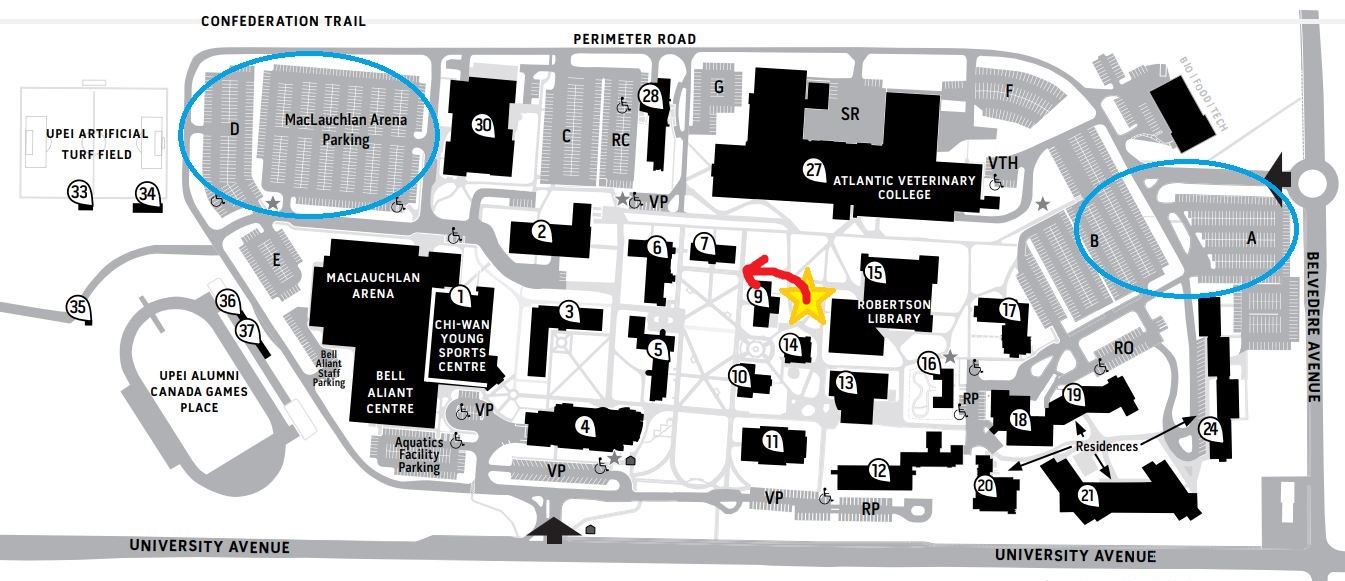
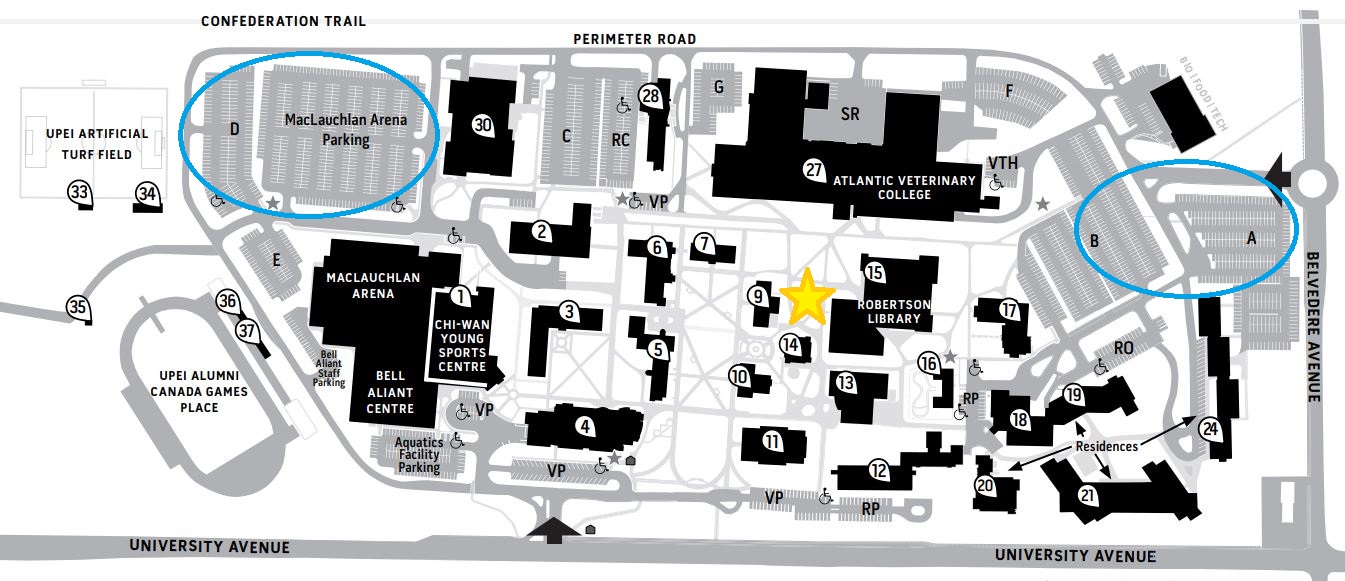
The event will be held between Memorial Hall (building 9) and Dalton Hall (building 2) and is marked with a red arrow coming out of a yellow star on the campus map above. Parking is available in campus lots A, (ungated) B, D, and the MacLauchlan Arena lot. Image is screenshot from map available on upei.ca
We will be having public viewing sessions with our solar telescopes on the following dates (every second Friday, with some adjustments for public holidays) from 12:30-2:00pm.
June 26 – CANCELLED due to cloudy weather
July 10 – CANCELLED due to cloudy weather
July 17 – ADDED due to previous cancellations – CANCELLED due to cloudy weather
July 24 – A successful, quiet viewing with 11 guests. Saw sunspots, prominences, and filaments.
August 7 – Another successful viewing with 11 guests. No large sunspots, but some large prominences and filaments.
August 12 – a special viewing for the partial solar eclipse, 1:50-4:00pm – Successful viewing with only an occasional cloud blocking the view momentarily. We had about a hundred guests. In addition to observing the silhouette of the moon, we saw a large prominence, a couple of filaments, and a few small sunspot pairs.
August 28 – 12:30-2:00pm – A successful but quiet viewing with just 7 guests. Saw three sunspots in a cluster, some small prominences, and some really long filaments.
Based on our experience, we anticipate that we will have to cancel at least half of the above dates due to cloudy weather. If it’s too cloudy to see the sun, then we will cancel that day’s event. This post will be updated in the event of any cancellations (typically by 9:30am on the day of the scheduled viewing).
(If we have too many cancellations in a row, we may set up a viewing on an alternate Friday date. The list above will be updated in that case.)
Meeting area
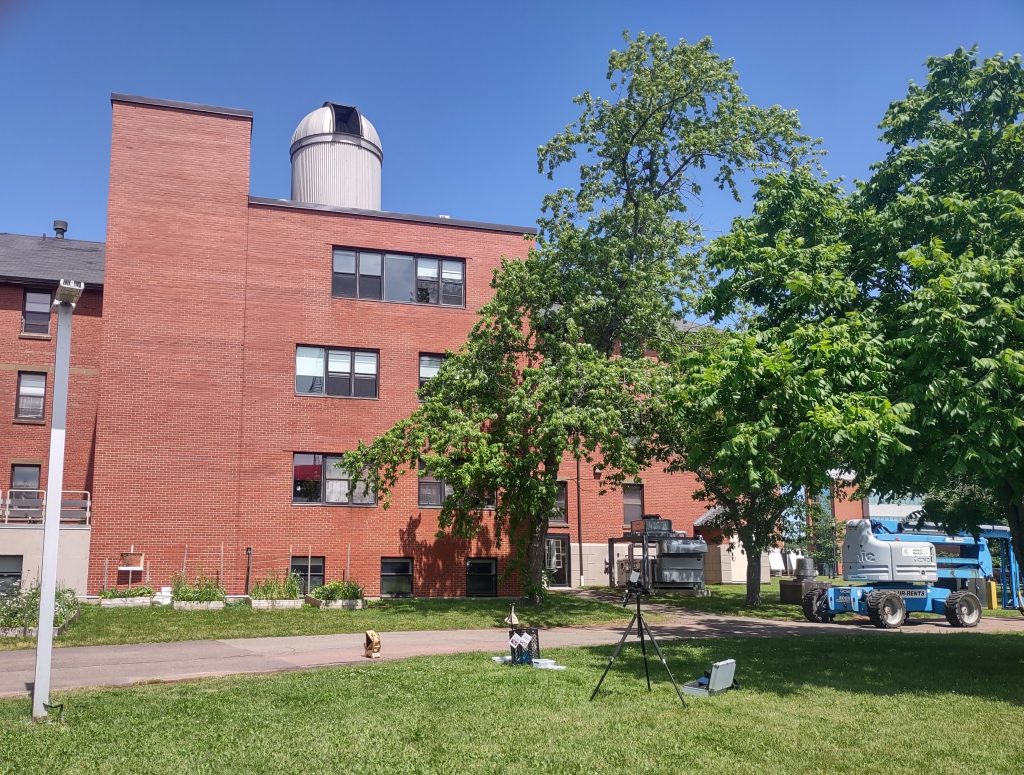
The meeting location for this event will be the grassy area between Memorial Hall and Robertson Library (see photo and campus map below). There you’ll find our hydrogen-alpha telescope that you can look through. We’ll direct you on how to find your way to the observatory to look through our other telescope when space is available. (Due to the observatory’s small size, we have to control how many people can go into it at once.)
The event meeting area is this grassy area next to Memorial Hall, where we will have two telescopes set up on the ground. This photo also shows our observatory on top of Memorial Hall. Photo by M. GloverThe event will be held between Memorial Hall (building 9) and Robertson Library (building 15) and is marked with a yellow star on the campus map above. Parking is available in campus lots A, (ungated) B, D, and the MacLauchlan Arena lot. Image is screenshot from map available on upei.ca
Accessibility
To reach our observatory, you must be able to climb stairs, because the building’s elevator can’t take people beyond the fourth floor, and the observatory is one storey above that. However, our ground-based telescope is accessible for people who are not able to climb stairs.
Age to attend
We welcome attendees of any age; however, to fully enjoy the viewing experience, anyone attending needs to be able to follow directions regarding how to look into a telescope eyepiece, what they can touch, and what they can’t touch. We leave it up to parents/guardians to assess whether the person under their care is capable of the above tasks. We will also have our Sunspotter telescope at the event, which shows sunspots and doesn’t require looking into an eyepiece.
Our Sunspotter telescope provides a view of sunspots on the photosphere that can be viewed by people who have trouble looking through a telescope eyepiece; for example very young children.
What you can expect to see
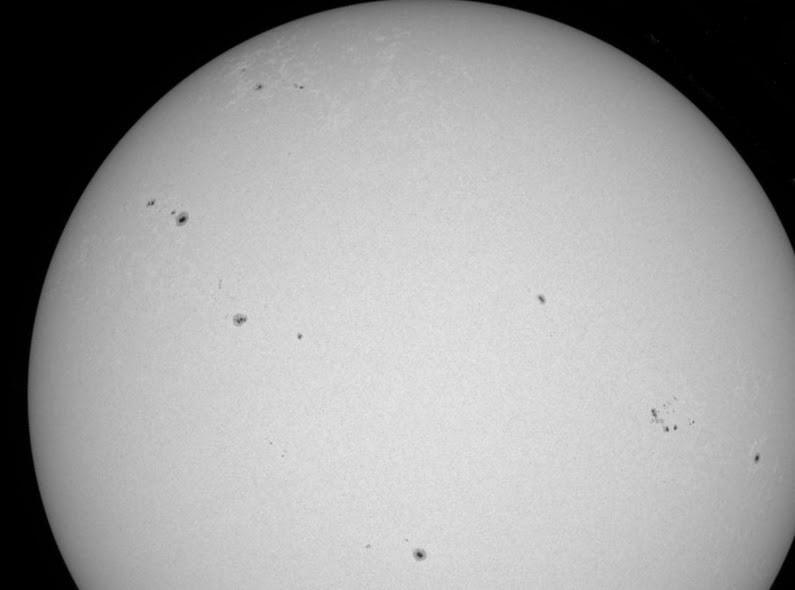
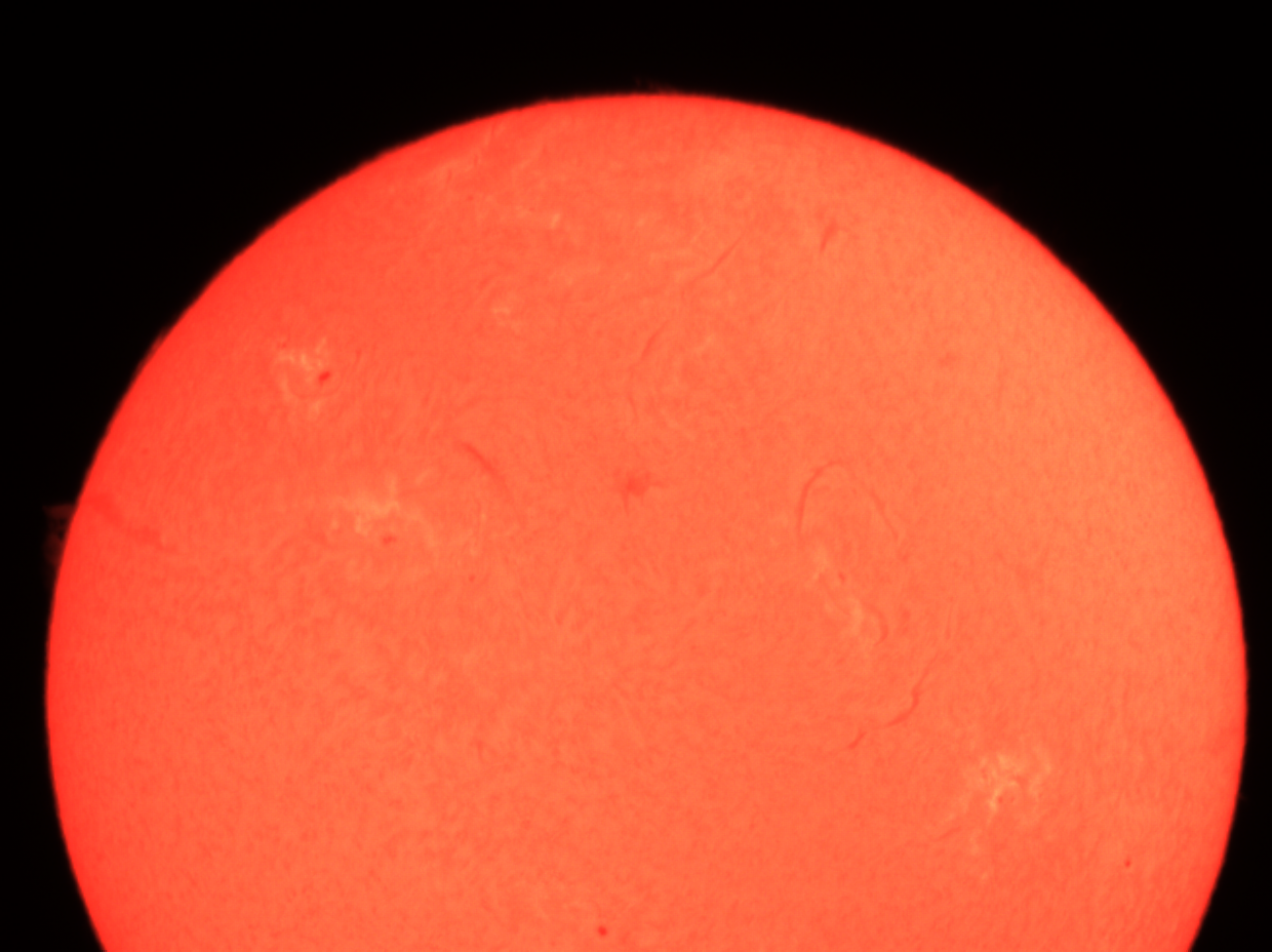
We will offer you views of two of the sun’s atmospheric layers, showing features caused by the sun’s dynamic magnetic activity. With a white-light solar filter on our observatory telescope, you will get to view the sun’s photosphere, which shows sunspots (see example image below). Through our hydrogen-alpha solar telescope, you will view the sun’s chromosphere – a dimmer atmospheric layer than can only be seen by filtering out all the light except the red emitted by hot hydrogen. The chromosphere shows prominences and filaments, which are protrusions of plasma. A web-like pattern covers the chromosphere, outlining supergranules. You may also see plages, which are bright areas usually surrounding sunspots.
Sunspots visible on the photosphere of the sun, as imaged by NASA’s Solar Dynamics Observatory (SDO) on May 14, 2024.The sun’s chromosphere (viewed through a red solar filter), showing dark filaments and bright plages on the solar disk, and prominences protruding along the edge. Image captured using UPEI’s hydrogen-alpha telescope on May 14, 2024.
We invite you to visit the Earl L. Wonnacott Observatory this winter to look through our telescope. We will be pointing our telescope at various objects of interest: the moon, planets, stars, nebula, and galaxies, depending on the date and sky conditions.
We will once again schedule viewings roughly every two weeks this semester, anticipating that at least half of the events will be cancelled by cloudy weather.
In the event of cloudy weather, this post will be updated to indicate if a viewing is cancelled.
The dates and times that we’ve scheduled are below. Note that the event times shift later as the dates get closer to the spring equinox.
Saturday, January 10, 6:00-8:00 PM – CANCELLED DUE TO CLOUDY WEATHER
Saturday, January 24, 6:30-8:30 PM – CANCELLED DUE TO CLOUDY WEATHER
Saturday, February 7, 7:00-9:00 PM – CANCELLED DUE TO CLOUDY WEATHER
Saturday, February 21, 7:00-9:00 PM – CANCELLED DUE TO CLOUDY WEATHER
Saturday, March 7, 7:30-9:30 PM – CANCELLED DUE TO CLOUDY WEATHER
Saturday, March 21, 8:30-10:30 PM – CANCELLED DUE TO CLOUDY WEATHER
Our summer solar viewing schedule will be posted in May.
If you’re coming to our event, meet us in room 417 of Memorial Hall. We’ll have some astronomy activities and information for a variety of ages that you can peruse while you wait for your turn to go up to the observatory.
Accessibility: You can take an elevator up to room 417, but it is necessary to climb stairs up one floor to the roof and into the observatory to reach the telescope.
We invite you to visit the Earl L. Wonnacott Observatory this fall to look through our telescope. We will be pointing our telescope at various objects of interest: the moon, planets, stars, nebula, and galaxies, depending on the date and sky conditions.
We will once again schedule viewings roughly every two weeks this semester, anticipating that at least half of the events will be cancelled by cloudy weather.
In the event of cloudy weather, this post will be updated to indicate if a viewing is cancelled.
The dates and times that we’ve scheduled are below. Note that the event times shift earlier as the dates get closer to the winter solstice.
Saturday, October 4, 7:30-9:30 PM: International Observe the Moon Night – attended by 21 people.
Saturday, October 25, 7:30-9:30 PM – CANCELLED due to forecast for rain showers
Saturday, November 8, 6:30-8:30 PM – CANCELLED due to cloudy forecast
Saturday, November 22, 6:30-8:30 PM – CANCELLED due to cloudy forecast
Saturday, December 6, 6:00-8:00 PM – CANCELLED due to cloudy forecast
Saturday, December 20, 6:00-8:00 PM: Attended by 80 people! We looked at Saturn.
If you’re coming to our event, meet us in room 417 of Memorial Hall. We’ll have some astronomy activities and information for a variety of ages that you can peruse while you wait for your turn to go up to the observatory.
Accessibility: You can take an elevator up to room 417, but it is necessary to climb stairs up one floor to the roof and into the observatory to reach the telescope.