
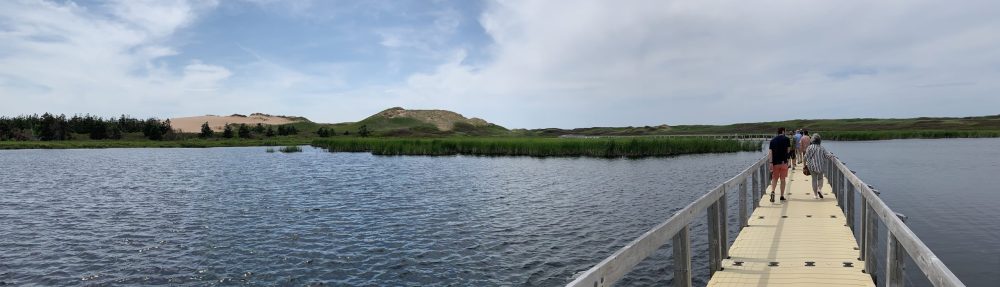
Funded Masters of Arts (Island Studies) position studying “Island Metabolisms and the Genesis of the Canadian Agri‑Food System.”
Apply by 1 July, 2026 for September start.


This position offers up to two years of funding ($20,000 per year) for a highly motivated graduate student in the UPEI Master of Arts in Island Studies (thesis stream) to join the GeoREACH Lab and undertake original, research-intensive work on islands in the Gulf of St. Lawrence and lower St. Lawrence River regions. The successful applicant will develop and apply historical and geographical research methods to the study of social ecological metabolism, with particular emphasis on the nineteenth and twentieth centuries. The project will involve close engagement with archival and secondary sources, including French‑Canadian materials, and will contribute to a deeper understanding of island food systems, energy landscapes, infrastructures, and socio‑environmental change. Applicants should hold an undergraduate degree in history, geography, Atlantic Canada studies, or a related discipline; fluency in French is considered an asset, and the ability to read and conduct research in French is required.
The student will work under the supervision of Dr. Joshua MacFadyen, Director of the UPEI GeoREACH Lab, and will become an active member of the SSHRC Insight Grant–funded project Genèse du système agro‑alimentaire canadien: trajectoires paysagères, infrastructures techniques et commercialisation, 1870–1930 (Genesis of the Canadian Agri‑Food System). Through this collaboration, the student will gain experience working within a larger, interdisciplinary research team and will have regular opportunities to collaborate with partners at Université du Québec à Trois‑Rivières, where the project is led by the principal investigator, Dr. Stéphane Castonguay. The position provides a strong foundation for advanced graduate training, scholarly publication, and professional development in historical geography, island studies, and environmental history.
Application Process:
Interested applicants should submit a brief (2-page) statement of research interests, a curriculum vitae, and the names and contact information of two academic referees directly to Dr. Joshua MacFadyen (jdmacfadyen@upei.ca) by 1 July for initial consideration (all applicants). In addition, applicants must submit a formal application to the MA in Island Studies (thesis stream) through UPEI Graduate Admissionsby the relevant institutional deadlines: July 1 for international applicants and August 15 for domestic applicants. Please include some of the same brief (2-page) statement of research interests in the Statement of (Research) Interests required for the application. Admission to the program is required for the appointment to proceed, and applicants are encouraged to consult UPEI Graduate Studies for full application requirements.
Full details at: https://www.upei.ca/programs/island-studies/scholarships
MHHK Project, Summer 2026
In partnership with the MITACS scheme, the University of Prince Edward Island is advertising two 12-week summer internships for students to work on the Mapping Historical Hong Kong spatial history project during Summer 2026. Students must be in the later three years of their undergraduate programmes, or enrolled joint undergraduate-to-masters programmes (please see eligibility requirements for further details). MITACS will provide successful applicants with funding for airfare, transportation, and accommodation, as well as a stipend for food and incidentals, any associated enrollment fees with UPEI, and a health insurance policy for the duration of their stay. Interested students must submit their applications by 17 September 2025.
Applications are due on 17 September 2025. It is relatively easy to apply, but it does require two letters of reference to be sent directly to the program by 24 September. To apply students should go to the Globalink website (below) and click “Apply Now.”
https://www.fulbright.ca/programs/undergraduate-students/fulbright-canada-mitacs-globalink-program
More details about the program of research are below, but to identify the project in the application system students need to enter “Larkin” in the “Faculty Last Name” field. The full ID and description are also pasted below.
https://globalink.mitacs.ca/#/student/application/projects
Feel free to reach out to Drs. Larkin or MacFadyen if you have any questions. We hope all eligible and interested candidates will apply!
Project ID 49248
Mapping Historic Hong Kong
Mapping Historic Hong Kong (MHHK) is a pilot initiative that uses mapping software to archive and visualise data regarding Hong Kong’s colonial development (1841-1997); and to make such information accessible to both a public audience and academic researchers through the creation of an open-access online mapping platform that allows users to explore Hong Kong’s growth and uncover a range of information about its urban development. The MHHK project’s overarching goal is to use digital mapping to develop an open-access online platform that spatially organises archival records, historical data, and visual materials related to Hong Kong’s colonial development between 1841 and 1997. Under this directive, the MHHK project has two primary objectives: I. To address the challenges of changing archival access and historical narratives about Hong Kong’s colonial past through spatially organised archival data and visual storytelling. II. To use the digital medium of mapping to cultivate a renewed interest in the relationship between history, space, and place. The project uses the QGIS platform to build a suite of georeferenced maps from primary source materials to visualize Hong Kong’s historic development. These maps integrate archival materials from the Hong Kong History Centre’s forthcoming Historical Photographs project and archives, the Richard Charles Lee Canada Hong Kong Library, and spatial data from the Hong Kong Public Records Office’s Land Registry. Affiliated with the Hong Kong Spatial Data Project, MHHK is part of a new effort to explore how digital mapping tools and new technologies can be integrated with historical research to encourage urban heritage and an appreciation for histories of urban space and/or place, while benefiting both academic researchers and the wider public.